
Making "Lost Cause" || Chapter 4
A producer's checklist of (almost) everything that must be done in pre-production for a low-budget narrative feature film (with examples + downloadable one-page PDF)

While making my new movie, Lost Cause, I documented the process and wrote a series of essays that examine and reflect on every facet of making, marketing and distributing an independent film in America at this critical and challenging moment.
Read the Prologue (on the challenges and opportunities of the current movie landscape)
Read Chapter 2 (on budgeting, fundraising, pitch decks and personal debt)
Reading Chapter 3 (on casting)

Introduction
This essay is broken into two parts:
Producer’s Pre-Production Checklist (with accompanying one-page PDF)
Checklist Breakdown
Part one is all killer no filler: (almost) everything a producer must do in pre-production. The PDF at the end of this section can be downloaded and used/adjusted as needed.
Part two is a deep dive into the items on the checklist, with personal examples drawn from my experience making Lost Cause (and maybe other projects too).
If you have any questions, or want to know about stuff not included in the essay, drop a comment below and we will continue the conversation there.
1. Producer’s Pre-Production Checklist
Every film is different. Every pre-production process should be slightly different, adapted to the needs and priorities of the specific project.
This is a general list of the most important tasks for a producer to do before production (not including budgeting/fundraising and casting). They are kind of in chronological order, but also the filmmaking process is fluid, and things happen as they happen. All this stuff is likely necessary, just not necessarily in this order.
Draft Operating Agreement for Your New LLC
Incorporate LLC for Production Using Operating Agreement
Open Production-Specific Business Bank Account
Contract Payroll Company
Open Business Credit Card with Introductory 0% Interest
Purchase Production Insurance
Secure Union Agreement(s) Based On Budget-Level
Research and Hire Crew
Finalize Cast/Crew Contracts
Secure Location(s)
Prep/Sign Location Agreement(s)
Hire Set Photographer and/or BTS Videographer
Plan and Book Lodging (if cast/crew traveling)
Plan and Secure Transportation as needed
Plan/Prep Set Meals
Purchase Snacks For Crafty
Establish Budget Disbursement Policy and Reimbursement Protocol
Rent Equipment
Devise a Shooting Schedule
Create and Send Out Call Sheets
Here’s the above info as a one-page .pdf that can be modified as needed. Dig it!

2. Checklist Breakdown
There are a million things to be done during pre-production. On a larger project, these jobs are done by a team. Generally, the bigger the movie, the bigger the team. On Lost Cause, I worked mostly alone.
1. Draft Operating Agreement for Your New LLC
I am not a lawyer and cannot advise on the specifics of creating an operating agreement. In theory, you could reach out to producer friends and ask them to share with you operating agreements they have used successfully in the past. Then — also in theory of course — you could use the language, terms and structures of these operating agreements as the basis for creating your own.
If it is your first time making a movie for more than $0, it is probably best to work with an entertainment lawyer (or producer) who knows what they are doing. If this isn’t your first rodeo, there are plenty of ways to create an operating agreement that will keep your chain of title clean.
A clean chain of title is the most important thing. How you get there is up to you.
2. Incorporate LLC for Production Using Operating Agreement
Different states have different processes and procedures for forming LLCs. Poke around on your state’s website and you’ll likely find LLC incorporation instructions. An LLC is essential to shield everybody involved from potential liabilities related to the production. It is better to be safe than sorry.
I encourage you to learn the incorporation process, at least in your home state, so you can handle it yourself on future projects.
There are also websites such as LegalZoom which help small businesses set up and manage LLCs (for a fee).
3. Open Production-Specific Business Bank Account
Pick a bank where you have a pre-existing relationship. This might enable you to access perks that save time and money. If you don’t have a pre-existing relationship with a bank, maybe one of your investors and/or producers does.
4. Contract Payroll Company
Work with companies you’ve had good experiences with in the past. If it’s your first time, reach out to trusted filmmaker friends for recommendations. I have used ABS Payroll on my past two features, and at this point I am very familiar with their protocol (which is clear and streamlined). Whenever I have a new project, I am able to reach out direct to my company contact, and he sets me up with a payroll specialist who would be a good fit. Everybody on their team is super informed, helpful and quick to respond to emails. Their fees are also competitive, reasonable and transparent. Having worked with a few entertainment payroll companies at this point, ABS is my favorite.
5. Open Business Credit Card with Introductory 0% Interest
This is something I would not necessarily recommend for everyone, but it can be useful for the right person. Proceed here with caution.
If you have a steady income, good credit and minimum debt, and are willing and able to put your own money into your movie, a 0% APR credit card is not the worst way to secure the last bit of funds to make a feature.
Do your research. Their are plenty of sites out there (like NerdWallet) that regularly survey and analyze all the available business cards on the market.
These are some key things I look for:
Is it free? Most credit cards are, but some have initiation and/or yearly fees.
How long does the initial 0% APR deal last? Nowadays, the best is usually around one year, but I’ve heard of offers lasting shorter and longer than that.
What are the limits and requirements of the 0% APR? For example, most of these 0% intro offers require paying at least the monthly minimum payment.
Are there any other useful benefits? Cash back? Extra points on travel?
I opened a chase business credit card for this production with 0% APR for one year and $1000 cash back after spending $5000 in the first three months. I maxed it out within a few months and paid it off before the introductory offer expired.
6. Purchase Production Insurance
For insurance, I have used MFE on my past few productions and all experiences have been very positive. You’ll need production insurance for many things, including renting equipment if the equipment value is above a certain dollar amount. Insurance is also crucial when renting trucks/vans and securing most (but not all) locations.
7. Secure Union Agreement(s) Based On Budget-Level
The only union we worked with on Lost Cause was SAG-AFTRA. I already wrote about SAG here, and there is plenty of readily-accessible info on the internet. There is signatory paperwork to take care of up front, union-approved contracts to be used once performers begin signing on to the project, and then “Production Time Reports” (Exhibit Gs) to be filled out and signed by performers at the end of each day on set. These Exhibit Gs are sent weekly to both SAG and your payroll company and play a pivotal role in staying compliant and ensuring your cast (and the union) are paid quickly and accurately.
Once your shooting schedule is locked — and you know who will be where on what day(s) — most lines on the Exhibit Gs can be filled out ahead of time. Do it on a computer, leave the important parts blank to be finalized the day of, and print a couple extra copies. During production, if everything stays on schedule, you just need to fill in the key details, then performers verify and sign and you’re good to go. Keep extra blank Exhibit Gs on set, especially if you don’t have a printer easily accessible. Make sure everything is printed out ahead of time if possible! Printers have a nasty habit of breaking the night before production.
8. Research and Hire Crew
Our crew was 6-8 people, depending on the day. About half the crew I had worked with previously, and the other half were new people who came to me via recommendations from trusted friends and collaborators. I like to work with people who can deliver at a peak professional level but who also aren’t afraid to get their hands dirty and challenge themselves on lo-fi projects.
I won’t dive into the nitty-gritty of the hiring process, but I will share the story of finding and hiring a Director of Photography (DP) for the film.
I had a very specific (and demanding) aesthetic in mind for the movie, and I also wanted to work with a DP I had not worked with before, who would push me in new directions. I was chatting with a smart film student of mine. I told him about Lost Cause and asked him who he thinks is the most interesting working DP.
“Jay Keitel,” he said without hesitation.
After researching Jay’s work, it was clear he would be perfect for the project (this video sealed the deal). I reached out to my friend Lindsay — a performer in the movie — because I had a hunch she might know him.
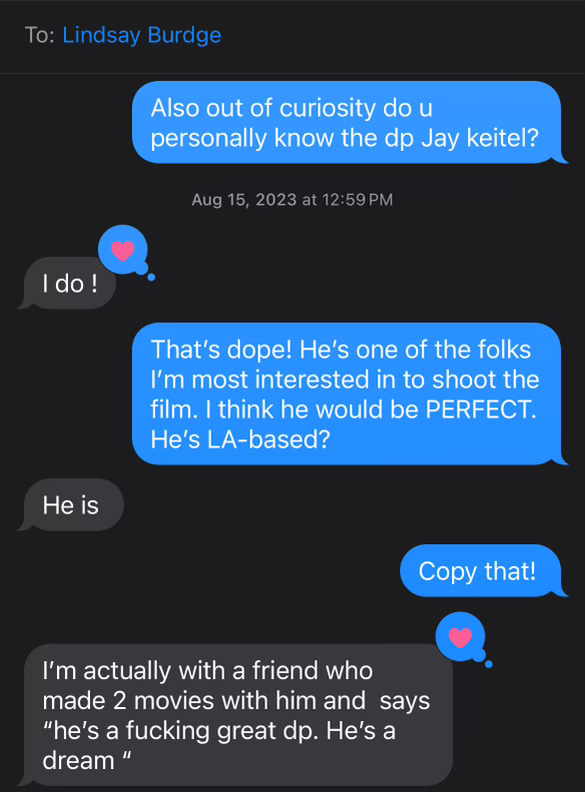
She connected me with him and, after a brief exchange over text, I sent him the script and accompanying materials. We hopped on zoom the following week and hit it off immediately. The project intrigued him and the ideas he brought to the table were spot-on. We talked a lot in our first convo about the band Pavement. Their musical style became a frame for us to think and talk about how we wanted the movie to look and feel (technical complexity hidden below a shaggy, deceptively simple surface).
He joined the team by the end of the call.
9. Finalize Cast/Crew Contracts
Take care of all contracts as early in the process as possible. Have respect for the fact that contracts are legally-binding agreements that can have potentially-adverse consequences for anybody and everybody involved (including the production and you personally). They are real and powerful documents. Take them seriously. There is nothing sadder than a good movie built on bad contracts. It is a house of cards, waiting to fall at any moment.
Have respect for your collaborators. A contract will usually be (at least) a couple pages long. Give everybody you are working with enough time to read their contract(s) properly and consult their own legal counsel as needed.
Contracts and tax documents can feel boring and unnecessary, but the worst thing in the world is sending fifty emails six months after production trying to get such-and-such person to sign such-and-such document. The best thing to do is get everything written down in a legally-binding contract as early as possible.
I have been involved with productions in the past where contracts and tax documents are being filled out on set by cast and crew. Not only is this a waste of precious production time, it is also a vibe killer. Avoid this at all costs.
10 & 11. Scout and Secure Location(s) and Prep/Sign Location Agreement(s)
If you wanna make this step as easy as possible, write a script that takes place in a single location!
Minus one shot, Lost Cause is a single-location film. I had originally written the film to be shot entirely in my apartment, but decided that wouldn’t work for a number of reasons both logistic and creative.
A few months before production, I was out on a walk with my girlfriend and dog, and we ended up on a street we had not walked down before. About halfway down the block, I noticed a small, nondescript sign hanging above an unmarked black door. The sign read “New Stage Performance Space.” I had never heard of it before. Upon returning home, I googled the space. I could tell from the photos that it would perfectly suit our needs.
I emailed the theatre and eventually connected with its director. Their rental rates were reasonable, and they were willing to give me an extra discount because I was local. They also had several projectors and a lighting grid which would be included for our use.
Because the space regularly did rentals for film productions, they had a boiler-plate location agreement we modified and used as the basis of our negotiations. The process was very straight-forward and required minimal back-and-forth.
12. Hire Set Photographer and/or BTS Videographer
Dan Mirvish wrote a whole essay on the importance of BTS footage. I can speak personally to the importance of hiring a professional photographer for as many hours as you can afford. The investment has tremendous value throughout the life-cycle of a film. Behind-the-scenes photography is useful when creating press kits and marketing the film. There are some graphic designers out there who are so talented that they can create powerful key art and ads using edited stills from the film itself. I’ve had to do this in the past and it is possible to create good key art without set photography. However, good set photography saves time and money in the long run by providing the production with more owned resources for marketing activities.
I could not afford to hire a professional set photographer for more than 3 hours. This was fine because our film was single location and there wasn’t much to photograph other than the cast and crew at work. One of our performers, Olli Haaskivi, mentioned a friend of his, David, was an accomplished portrait and headshot photographer looking to get into set photography. He connected us, and David agreed to be our set photographer for a rate that worked with our budget.
Additionally, I encouraged crew members to candidly snap photographs on their phones during production. Some of the photos I have used most to market the film were taken by our key grip/gaffer, Griffin.
Between David’s official set photography and unofficial photos by Griffin and other crew members, we had more than enough behind-the-scenes images for any and all future marketing activities.
13. Plan and Book Lodging (if cast/crew traveling)
Book a nice hotel as close to the location(s) as possible. Call ahead and make sure they know that the guest checking in is not the person who booked the room.
14. Plan and Secure Transportation as needed
I hate renting big gear trucks for production, and avoid it whenever possible. I think 50-60% of the gear in any given truck is never used. Most productions tend to rent way more than they need. Also, big gear trucks are tough to drive anywhere, and they become absolute nightmares in New York City.
Because we had a small crew, limited gear and just one location, I knew we could make it work using just taxis and rideshares. Though this ended up being a bit more expensive than anticipated, it still saved us time, money and headaches.
I discourage the use of personal vehicles during production because it puts an undue liability on crew members (who also might be friends). Do what you must, but understand the associated risks and don’t take advantage of people.
15. Plan/Prep Set Meals
Because our team was so small, I planned to reach out to local restaurants to cater production. However, when I told my friend John about this, he offered to provide, prepare, and deliver all the meals himself.
“I can’t put in any money right now,” he said, “so consider this my contribution.”
John is an incredible cook and I was happy to oblige.
The first thing I did was reach out to cast and crew to see if there were any allergies or dietary restrictions. From there, John and I hopped on the phone and brainstormed delicious meals that would meet the needs of the team. It took about an hour for us to get the meal plan together. After that, I told John when and where to arrive, and he took care of the rest.
16. Purchase Crafty
Crafty is the snacks and drinks you have on set, available to cast and crew at all times.
Yummy, clean and healthy meals, snacks and drinks are an invaluable component of a properly-run set. A well-fed team usually equals a happy team. I always like to ask cast and crew about their favorite foods and drinks, and then make sure to have this stuff available on set. Buy more crafty than you think you’ll need about a week before production. Try to get it all in one big CostCo run. Worst comes to worst, you’ll have extra snacks in your house for a few weeks after production.
17. Establish Budget Disbursement Policy and Reimbursement Protocol
Crew will need to make purchases before production. Figure out the logistics of how these purchases will be made. Will department heads have a copy of the credit card, or will they send stuff to you to purchase?
Create a simple Profit and Loss (P&L) statement as early as possible to keep track of all expenses. Don’t wait until production to start documenting this information.
Make sure that cast and crew keep their transportation receipts, along with any other miscellaneous receipts from production-related expenses. Develop a system that allows cast and crew to easily file these receipts and quickly receive reimbursement if they paid out-of-pocket. A “system” can simply be a google sheet or even just a clear and well-organized email protocol. As soon as I have documentation of the expense, I reimburse using a cash app like Venmo or Zelle. I also keep a small amount of petty cash on set to be disbursed as needed (just make sure to keep track of where it all goes).
18. Rent Equipment
Some productions work with lots of different rental houses, tracking down the best deals on all the needed equipment and building the gear truck piece-by-piece. I’ve seen a director/producer do this in the past and it was something to behold. They were able to initially bring the equipment budget down by about 15%. However, equipment pick-ups and drop-offs during that production became a distracting hassle. Our entire crew was wasting unnecessary amounts of time each day keeping track of what came from where and what was due back when. We ended up losing a bunch of equipment and ultimately went over-budget.
Since that debacle, I always work with as few rental houses as possible.
There were a few rental houses in NYC that had what we needed, but only one, LVR, was in Manhattan (about a 20-minute drive from our location). LVR had a great reputation, and they were able to offer a deal because we were getting all of our equipment from them.
An essential thing to know about rental houses: they charge by the day, but they treat the weekend as one day. Different rental houses have different rules for when the weekend “starts” (when you can pick up your equipment). Sometimes, pickups start at 8am on Friday, or at noon, or at 2pm. On a film production with only a handful of shoot days, every second matters. LVR was special because their weekend started on Thursday at 4pm. We could get the equipment and prep it the day before, and then start shooting immediately on Friday morning. Every other rental house would’ve charged us for an additional day if we wanted to pick the equipment on Thursday for a weekend shoot. Working with LVR was a no-brainer.
19. Devise a shooting schedule
Coming up with a shooting schedule is actually a lot of fun if you like complex puzzles with countless variables and moving pieces.
You must consider the availability of performers and locations and adhere to union and labor regulations. Crucially, you must also understand the pace of your team and the demands of the production.
Break the film into scenes, then break those scenes into shots, then determine how long each shot should take. Be realistic. Whenever possible, set aside a bit more time than you think you’ll need. Some scenes will be more complex than others. Conversations with cast and crew during pre-production should help you identify and plan for the biggest challenges you’ll encounter on set.
When figuring out a shooting schedule, post-it notes are your best friend. Write each scene on a separate post-it. Note the performers in each scene and how much time each scene should take. Then find a blank wall and start posting up scenes and moving them around until it all flows and makes sense.
You can also do this digitally, using a program like Miro.
We shot Lost Cause in four days. Two days were spent recording the musical sequences, and two days were spent working with actors.
20. Create and Send Out Call Sheets
The call sheet is basically the daily breakdown, issued to cast and crew. It explains who has to be where when, and the scene/shot order of the day. Sometimes call sheets are created last minute, but I created our call sheets about a week before production, once the shooting schedule was locked.
I may be a weirdo, but I think there is something meditative and almost ritualistic about creating call sheets. I don’t spend too much time on the aesthetic of the call sheets but I do like to include quotes that speak to our goals and intentions with the project.
For the Lost Cause call sheets, I looked to Robert Bresson for wisdom and used the following four quotes:
Not to use two violins when one is enough.
The greater the success, the closer it verges upon failure.
A whole film made of good images can be detestable.
Nothing too much, nothing deficient.
21. Now Go Make Your Movie!
Have an absolute blast doing it. There is really nothing like being on set and collaborating with awesome, talented artists. Treasure every moment of it.
Passing this great information onto Ray and their fellow filmmakers! Thanks Adam!
Thanks for sharing these resources! 🙌🏼